

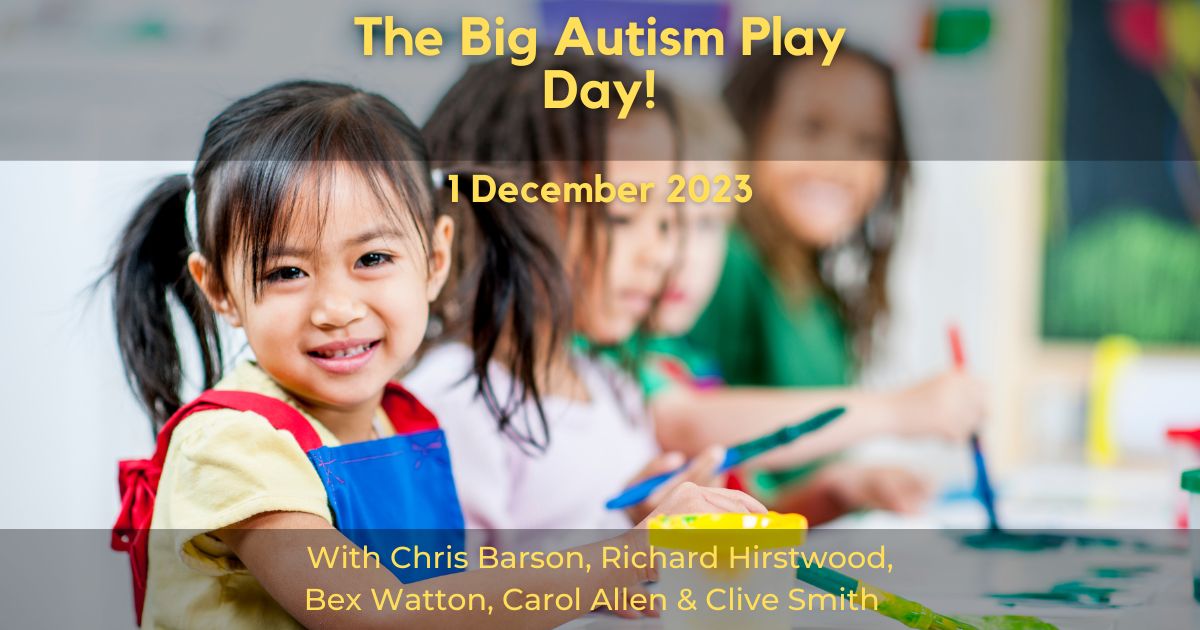
The Big Autism Play Day 2023

with Chris Barson, Richard Hirstwood, Clive Smith, Carol Allen, Bex Watton and Simply Sensory!
1 December 2023: 9 am – 3 pm
Play provides some of a child’s first opportunities to explore the social world and work out the meaning and use of language. We have lift-off when solitary play becomes side-by-side play and then progresses to joint/cooperative play with another little human! Social experts in the making. But all of this might not come so quickly to an autistic child.
On the BAPD, we’ll explore the barriers to play and learning in autism and how you can help learners over them!
But children with autism do play. Of course, they do. But don’t mistake playing ‘differently’ from others as ‘can’t’ or ‘won’t’ play. Autism comes with a pattern of learning strengths and preferences.
The BAPD will explore the uniqueness of autism and show you how to harness it to get great play and learning outcomes.
Engaging in play is driven by curiosity. Therefore, creating intrinsic motivation to play for learners with autism is critical.
On the BAPD, we explore building intrinsic motivation in your classroom!
There is an increasing recognition that sensory differences are a big part of autism. However, the sensory sensitivity difficulties sometimes mean classrooms aren’t always optimal learning environments for autistic children.
The BAPD will show you can harness outdoor play’s power to engage children on the spectrum with outdoor fun!
Our learners with autism often fixate on certain types of play or specific play activities. These form a safe place of predictable pleasure.
We explore the nuts and bolts of creating a tempting play diet for your learners with autism!
Sensory play engages the senses and allows learners to strengthen and develop their sensory systems and learn.
Let’s add a broader range of play opportunities to our classroom repertoires to hook our learners in!
Messy play (festive style) may not be your first thought for learners with autism. But carefully offered, it can be accessible to all! Helen and Julie offer ways to reduce the physical barrier to messy play and how to bridge the gap between dry and wet messy play.
9 am Admissions welcome and introductions!
9.10 am Warm-up!
9.20 am Session 1: ‘Autism, play and communication – Making connections’ with Chris Barson
Speech, language and communication needs (SLCN) run through the middle of autism. Responding to them is job number one for play practitioners, parents and therapists. The building blocks of early communication start getting put into place from the moment we are born (and there is good evidence that they begin even before that!) So how does autism impact the development of speech, language and nonverbal communication? What’s the latest thinking? What works? This session will try to answer these questions and guide practitioners through the following:
Effective language learning through play
Adapting our communication to get the best fit for autism
Moving from functional communication to emotional connection
9.55 am Session 2: ‘Breaking down the barriers to play with children with autism’ with Clive Smith
The BAPD sounds terrific, but many commentators on learners with autism tell us that this group doesn’t play. Well, this session will confirm that they play but often, differently from other children. We will look at stages of development as they are linked to play and then consider how learners with autism will play in these stages. Finally, we will consider how learners with autism react to their environment and the objects within it uniquely. Parents, carers and teachers find their intuitive play skills don’t work and often don’t know how to play with their child. Therefore, this session will offer suggestions for how to join them in their play productively yet also influence their development through play whilst enjoying the time together!
10.30 am Session 3: ‘Sensory Play!’ with Richard Hirstwood
In this practical session, Richard will explore many ideas for creating sensory play opportunities in your classroom. By encouraging engagement in learning using the senses, we offer learners with autism the opportunity to learn how to play. Understanding their sensory profiles means you can provide the perfect sensory play for them!
11.05 am Coffee and mini online learning activity
11.45 am Session 4: ‘Can I tempt you?’ with Carol Allen
Our learners with autism often fixate on certain types of play or specific play activities. These form a safe place of predictable pleasure. Whilst respecting the need for this, this session will consider different types of play that form part of daily life. Is it possible to create a play diet? What would a taster menu of play activities look like? Should we move learners beyond their comfort zone when play is involved?
12.20 pm Session 5: ‘Outdoor Play’ with Richard Hirstwood and Carol Allen
Designing your outdoor space to use effectively for play and learning is essential if we advocate anytime/anywhere learning. Planning what will happen (or what you would like to happen) may be crucial, but you will need to observe free play and understand its impact. This session will show you how to offer opportunities for mastering skills and encourage the learners to be themselves away from the restraints of the classroom. We will provide a wide range of ideas to utilise the opportunity for creating better physical health and motor skills, stress relief, creativity, stronger communication skills, increased attention and cognitive abilities.
12.55 pm Morning Plenary & housekeeping
1 pm LUNCH
1.45 pm Session 6: Festive let’s get messy with Simply Sensory!
Helen and Julie will cover the three stages of messy play. They explain why messy play is important, how to bridge the gap from dry to wet messy play and provide lots of Christmas based messy play ideas. They offer suggestions to overcome the physical barriers to messy play to make it accessible and fun for all!
2.25 pm Plenary, Q & A & ‘Share a tip!’
3 pm Thank you and goodbye!
NB Extra recorded session!
‘If it’s fun, they will come: building intrinsic motivation in the classroom’ with Bex Watton
Bex explores making learning through play an irresistible activity in your classroom. By considering intrinsic motivation and how to harness its effect, you will easily engage learners with autism in play.
Richard Hirstwood
Chris Barson
Clive Smith
Carol Allen
Bex Watton
This course will be appropriate for classroom practitioners from special schools and colleges, mainstream settings with specialist SEN provision and early years settings, and working with pupils with autism, and severe/complex learning needs or both.
All the resources from this event will be in your account at online.hirstwood.com. You will access these using the email address on the booking form and your password (instructions in the joining information for creating your password.)
Here you will find:
a digital recording of the event
resources shared or signposted during the session
a transcript of the Zoom chat
your certificate of attendance
These will be available for 10 days after the event.
£165 plus VAT per place
You can choose to pay by credit card for this booking. You can also request an invoice by confirming your booking by entering a Purchase Order Number on the booking form.
This live & online event now has a certificate of attendance to download!
This live & online event now has a dedicated Chat Room! Open the day before the event, chat with fellow delegates or tutors or ask questions. Open for ten days after the event.
NEW FOR 2022!